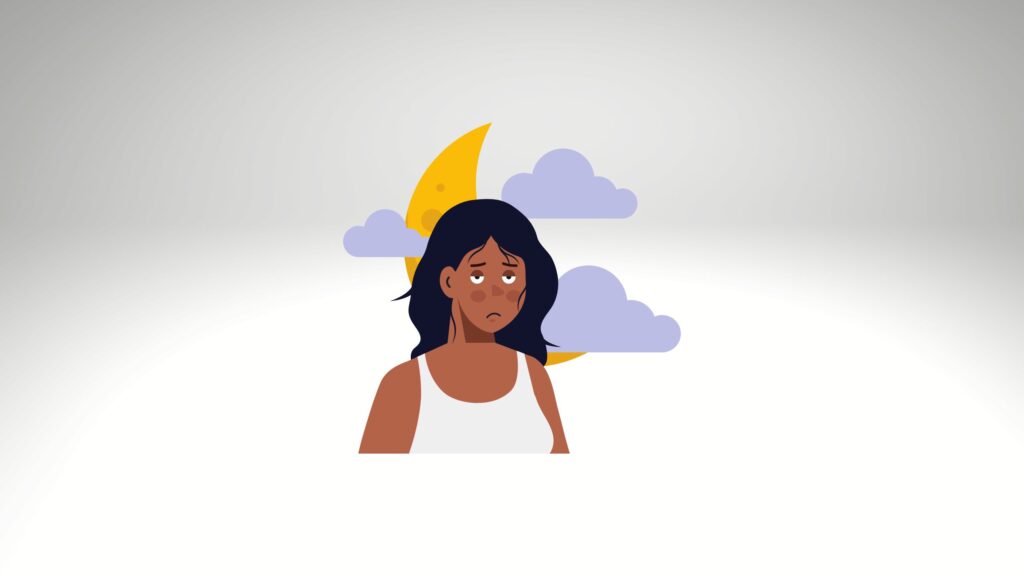
We have already chatted about how sleep deprivation can affect our appetite and mood, which can lead to overeating. Today I want to build on that by reviewing a study by Wang and friends that looked at the significance a lack of sleep can have on your fat loss goals.
So Wang and their pals got together to perform an 8-week randomized controlled trial with adults that were obese or overweight. They created two groups, with all participants being given a calorie-restricted dietary pattern to follow. One group was also instructed to restrict their time in bed by ~90 minutes 5 days a week. The other two days, they were allowed to sleep as much as they wanted.
“Sleep Deprivation Study: Show Fascinating Results”
It was found the sleep-restricted group reduced their time asleep by ~1 hour for five days a week, and on the other two days, they tried to make up for the lack of sleep by sleeping for ~1 extra hour compared to normal. If we are being honest, this sounds like my normal sleep routine during the week.
As for weight loss – it was found that both groups lost the same amount of weight over the 8-week period ~3.2kg or ~7lbs.
I know what you’re saying, ‘Wow, cool story, bro. So sleep deprivation had no affect on weight loss.’
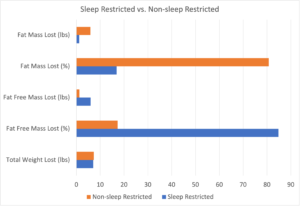
I agree! Both groups lost a similar amount of WEIGHT. However, when we look closer at what made up the weight that was lost in each group, we see a fascinating result! In particular, the authors of this study looked at the amount of Fat Mass vs. Free-Fat Mass* that was lost by each participant.
*Fat-Free Mass = is your mass that does not have fat, ie. organs, tendons, blood, and muscle.
Sleep-Restricted Group vs. Control Group:
- Fat Free Mass Lost = 2.7kg (6lbs) vs. 0.6kg (1.3lbs)
- Fat Mass Lost = 0.5kg (1.2lbs) vs. 2.7kg (5.9lbs)
If you like pictures, check out the graph below.
When people say they want to lose weight, what they mean is they want to lose fat. However, anytime any human loses weight, some of the weight loss will be in the form of muscle and fat. It is inevitable. Preserving as much muscle as possible while losing weight is in our best interest, as muscle is good. Muscle makes us stronger and helps us burn more calories by existing. Which means we can maintain our weight more easily.
Study Finds Calorie Deficit and Sleep Deprivation May Lead to Muscle Loss
In weight loss studies, a loss of fat-free mass generally includes a loss of muscle mass. So the results of this study show that individuals who are in a calorie deficit and sleep deprived not only lose significantly less fat, they are likely losing significantly more muscle.
On the contrary, the group that was not sleep-restricted retained a greater amount of fat-free mass, therefore, more muscle mass. One thing that makes this difference even more interesting is that none of the study participants were performing resistance training, which has substantial benefits in preserving free fat mass. Therefore, sleep alone can help to lose fat and retain muscle mass.
Is your mind blown? Cause mine sure is!
 Now a question I am sure will come up: Will similar results be seen with a medication like Wegovy or Mounjaro?
I can’t say for certain as we don’t currently have any studies looking at this question. However, based on how these medications work, I would argue we would see very similar results if an individual was sleep deprived and taking one of those medications. The results would likely be more pronounced with the more weight that is lost.
So if you didn’t have a reason to work on your sleep, now you do!
Until next time, my friends. Always remember that small tweaks lead to massive peaks.
 Dr. Dan
Follow me on social media for regular updates – @TheOfficialDrDan
Subscribe to my newsletter for a heads-up on all new content.
Sharing is caring! Here’s the link for social, email, and even text – https://healthevolved.co/sleep-deprivation
If you need some coaching support on your weight management journey, you can book a consultation with me to see if you’d be a good fit for our program.
Questions or comments? Please send them my way on our Contact Us page!
References:
Xuewen Wang, Joshua R Sparks, Kimberly P Bowyer, Shawn D Youngstedt. (May 2018). Sleep. Influences of sleep restriction on weight loss outcomes associated with caloric restriction. Retrieved from: https://doi.org/10.1093/sleep/zsy027